
How I Rebuilt This Site’s Own SEO Structure
Most of what I write about is theory until you see it applied somewhere real. So instead of another client example, here’s what I actually did on this site, griffithpromarketing.com itself, over the past little while. Every screenshot, every decision, and every mistake I mention below happened on this exact set of pages you’re reading right now.
The short version: this site had ten articles and a pillar page that were all loosely related to the same topic, why websites don’t rank, but they weren’t working together as a system. No consistent internal linking, competing titles, no clear hierarchy telling Google which page should own the main search term. So I rebuilt the whole thing into a proper cluster, and this post walks through exactly how.
What the Site Looked Like Before
Before any of this started, the ten articles existed, and they were reasonably good on their own. Detailed, written in plain language, covering real problems like homepages that don’t rank, service pages that stay invisible, and websites that lose rankings after doing well for a while. The content itself wasn’t the issue.
The problem was that none of it was talking to the rest of it. There was an old pillar page at a completely different URL than the one I ended up using, and most of the ten articles still linked to that old address instead of anywhere current. A couple of articles were essentially covering the same ground under different titles, which meant they were quietly competing with each other for the same searches instead of splitting the territory cleanly. And the article about local SEO mistakes and the one about why Australian websites struggle to rank were close enough in subject matter that they risked cannibalising each other too, unless I gave them genuinely distinct angles.
None of this was visible to a reader working through one article at a time. It only showed up once I looked at the whole set side by side and started mapping out where every link actually pointed.
Why Loosely Related Content Isn’t a Cluster
It’s worth explaining the actual problem here, since it’s more common than people realise. Having ten articles about a similar topic doesn’t automatically mean Google reads your site as an authority on that topic. What tells Google that is structure: one page clearly acting as the entry point, every supporting article linking back up to it, and a small number of deliberate, varied anchor texts doing that linking rather than the same phrase repeated everywhere.
Without that structure, you’ve just got ten separate pages that happen to be about similar things. Each one has to earn its own authority from scratch, and worse, they can end up splitting whatever authority the site does have instead of reinforcing each other. That’s really what topical authority means in practice, not writing more content, but making sure the content you already have is pointing at itself in a deliberate, hierarchical way.
What the Rebuild Actually Involved
I started with the pillar page, the one meant to be the main entry point for the whole topic, and rewrote its title, structure, and internal links so it clearly pointed down to all ten supporting articles, grouped under four categories: indexing and visibility problems, ranking instability, SEO fundamentals, and how Google evaluates trust and local relevance. Each of those four groups got its own section on the pillar page, with the articles inside it listed and linked clearly rather than scattered throughout a wall of text.
Then I went through each of the ten articles one at a time, matching their titles to how people actually search rather than how they sounded internally, tightening the keyword each one was meant to own so they stopped overlapping and competing with each other, and making sure each article linked back up to the pillar exactly twice, using two different phrasings rather than repeating the same anchor text, plus one link sideways to a genuinely related article in the same cluster. That two-up, one-sideways pattern wasn’t arbitrary, it’s what keeps the pillar page collecting more inbound authority than any single article, while still giving every article at least one neighbour to reinforce.
I also went through and wove a small set of shared phrases across the cluster, things like “why my website is not ranking” and “SEO ranking problems,” assigning each phrase to two articles rather than letting every page chase the exact same wording. That’s what stops a cluster from looking artificially repetitive to Google while still reinforcing that all ten pages belong to the same topic.
Along the way I added proper schema to each page using Rank Math, which is what handled the keyword targeting and structured data across the whole cluster, fixed a handful of internal links that were quietly pointing at the wrong URLs, and made sure the affiliate tool recommendations sitting in a few of the articles were only there where they actually solved the problem being discussed, not just dropped in everywhere.
Being Deliberate About Where Affiliate Links Actually Go
This part is worth being specific about, because it’s where a lot of SEO content quietly loses trust without the reader ever quite noticing why.
Some of the ten articles are genuinely diagnostic, the kind someone reads while trying to understand what’s wrong before they’re anywhere near ready to buy a tool. Articles like the one on blog posts getting no traffic, or new websites sitting in what’s sometimes called the sandbox period, fall into that category. I deliberately kept those affiliate-free, even though a plugin recommendation would have technically fit somewhere in the text if I’d gone looking for a spot. The logic is simple: if every single page pushes a tool, readers stop trusting any of the recommendations, including the ones that are genuinely useful.
Other articles are much closer to the moment someone’s ready to act, a page that explains exactly why service pages don’t rank and walks through the fix is a reasonable place to mention a tool that helps with that specific fix. So that’s where the tool mentions live, tied to the exact problem being solved in that section, not stapled onto the top or bottom of the article as an afterthought.
The same principle applied when I built a separate interactive diagnostic tool for rankings and traffic that had dropped after doing well. It would have been easy to make every branch of that tool end in a product recommendation regardless of what the person actually diagnosed. Instead, the tool only surfaces a specific product once the evidence genuinely points there, and it says so plainly when nothing technical is actually wrong and the real answer is something like a demand shift or a competitor publishing something better.
Tying the Homepage Into the Same System
Once the cluster and the diagnostic tool existed, the homepage needed to actually route people into them rather than just describing that they existed somewhere on the site. I rebuilt the “pick your problem” section on the homepage into three honest options, no traffic at all, traffic or rankings that dropped, and traffic that isn’t converting, each one linking to the actual page built for that exact situation. The middle option routes straight into the diagnostic tool, since that’s genuinely the scenario it was built to handle.
I was careful not to dress that section up with invented statistics either, no fake “70 percent of visitors have this problem” type claims sitting on the homepage before anyone’s clicked anything. It’s just three honest descriptions of common situations, and people pick whichever one actually matches them.
The Last Step: Telling Google to Look Again
Once everything was updated, the final piece was going into Google Search Console and requesting Google recrawl the pages that had changed the most, starting with the pillar page itself.
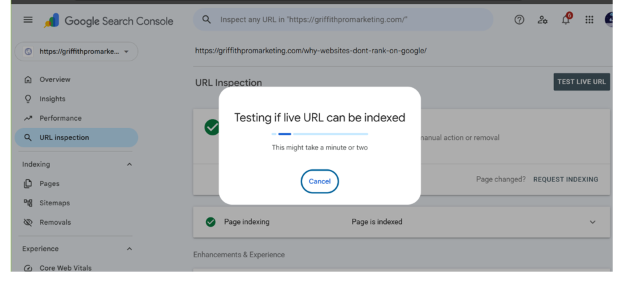
This is the short loading state Search Console shows right after you click Request Indexing, it usually takes a minute or two to clear.
The page was already indexed, it wasn’t a new page fighting to get discovered for the first time. This step is really about telling Google “this page changed meaningfully, come look again sooner rather than waiting for your normal crawl schedule to get to it.”
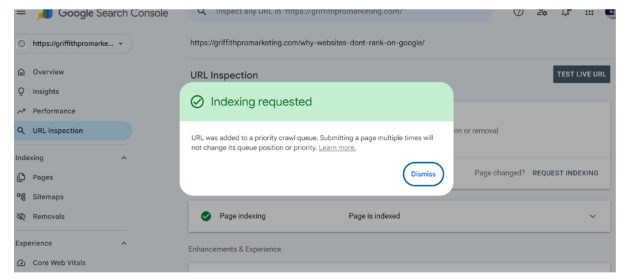
Confirmation that the request went through and the page was added to a priority crawl queue.
Worth being clear about what this step does and doesn’t do. It doesn’t guarantee a faster ranking improvement, and submitting the same URL repeatedly doesn’t push it further up the queue, Google says as much right in that confirmation message. What it does is remove the waiting game, instead of hoping Google notices the changes on its own schedule, you’re explicitly flagging that something worth a fresh look just happened. I did the same for the sitemap too, resubmitting it through Rank Math once the structure changes were live, so the updated internal linking would actually be visible to Google in one place rather than only discoverable page by page.
What I’d Do Differently Next Time
A few things came up during this rebuild that are worth mentioning honestly, since they’re the kind of small mistakes that are easy to repeat if you don’t watch for them.
The biggest one was slug inconsistency. A couple of pages, like the one about how many pages a website needs and the one about blog posts getting no traffic, had links pointing at slightly different versions of their own URL scattered across different articles, one saying “how-many-pages-needed,” another saying “how-many-pages-you-need.” Neither was wrong exactly, they’d just drifted apart over time as different articles got written and linked to each other without anyone checking the actual live slug first. Fixing that meant going back through every article a second time just to confirm which version was real and correcting the rest to match. Next time, I’d check the actual published URL before writing a single internal link to it, rather than after.
The second thing was keyword phrasing versus what Rank Math actually checks for. I’d assigned each article a shorthand focus keyword during planning, but Rank Math checks for the literal phrase sitting in your title and content, not a conceptually similar version of it. A few articles came back with focus keyword errors purely because the planned keyword and the actual title wording didn’t match word for word. That’s an easy fix once you notice it, just align the two, but it’s a reminder that planning language and published language need to be the exact same thing, not just close.
The third thing, and this one’s more of a judgement call than a mistake, was resisting the temptation to add more affiliate links than the content actually supported. It would have been straightforward to add a tool recommendation to every article, and it likely would have looked fine to a casual reader. But a handful of the ten articles just don’t have a genuine technical fix to sell, they’re diagnostic or conceptual pieces, and forcing a product into them would have been the kind of thing that erodes trust slowly rather than obviously. Leaving four of the ten articles affiliate-free entirely was the right call, even though it meant fewer placements overall.
Why I’m Sharing the Process, Not Just the Result
Most SEO case studies skip straight to a graph going up and to the right. That’s fine when you have one, but it hides the part that’s actually useful to someone trying to do this themselves, the sequence of decisions and checks that got there.
If you’re working through something similar on your own site, the order that mattered here was fixing the structure first, cleaning up the linking and keyword overlap, deciding honestly where any monetisation actually belonged, and only then asking Google to take another look. Requesting a recrawl on a page that’s still got the same underlying problems doesn’t really do much. Fixing the problems and then asking Google to look again is a different thing entirely.
It’s also worth saying that none of this was a single afternoon’s work. It was closer to going through the site article by article, checking each decision against the ones already made for the rest of the cluster, and catching inconsistencies as they turned up rather than assuming everything lined up just because it had been planned that way. That’s really the honest version of what “rebuilding a site’s SEO structure” looks like in practice, less a single dramatic fix, more a long list of small, deliberate corrections that add up.