
The First 28 Days: How We Watched a New Site Learn What It Actually Wanted To Be
There’s a version of this case study that just shows you a graph going up and calls it a day. That’s not this one. What actually happened in the first 28 days of griffithpromarketing.com wasn’t a straight climb, it was messier than that. We published things that turned out to be competing with each other for the same search terms, we watched Google reward one page far more than we expected, and about two weeks in we made a call to pull two live posts back into draft because they were quietly working against the site instead of for it. That decision, more than any single ranking, is the real story here.
This is the full walkthrough, day one through day twenty-eight, with the actual Search Console numbers, the query-level data that made the cannibalisation problem visible in the first place, and the pillar structure we rebuilt the site around once we saw what was really going on.
Day one: quiet, scattered, and already telling us something
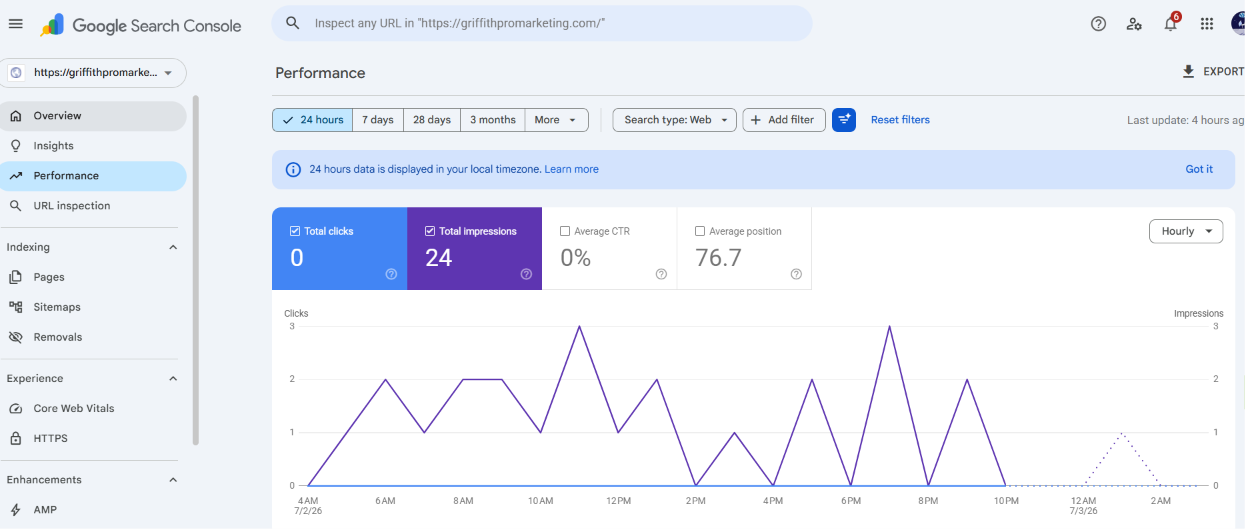
On day one the site had 24 impressions, zero clicks, a 0% click-through rate, and sat at an average position of 76.7. Nothing about that screams success, and it wasn’t meant to. What mattered wasn’t the volume, it was where those 24 impressions came from. Twenty-two of them landed on a single page, our three-way comparison of Rank Math, Yoast, and All in One SEO. The other two scattered across the Commission Factory guide and a post about fixing website speed.
More interesting than the pages was the geography. In that first 24 hours, impressions came in from the United States, the United Kingdom, Spain, Colombia, India, Australia, and Iceland. Seven countries, day one, no backlinks, no history. That’s not a fluke of a small sample size, it’s a signal about the query itself. “Rank Math vs Yoast” isn’t a local Australian search, it’s a global one, because WordPress site owners everywhere are asking the same question when they’re setting up SEO on a new build. We hadn’t done anything special to earn that spread, the topic itself was just naturally borderless, and Google matched us to it early because the comparison was genuinely structured to answer the question three different ways instead of two.
Seven days in: one click, and the first real signal about which page actually mattered
By day seven, impressions had jumped to 280, average position had improved slightly to 73.3, and CTR sat at 0.4%, still off the back of a single click. That click went to the Commission Factory Australia guide, which picked up 23 impressions and 1 click in that seven day window. The Rank Math vs Yoast piece kept climbing on its own, up to 244 impressions for the week.
This is also where the query data starts to get genuinely useful, because it tells you something the page-level numbers can’t: what people were actually typing to find us.
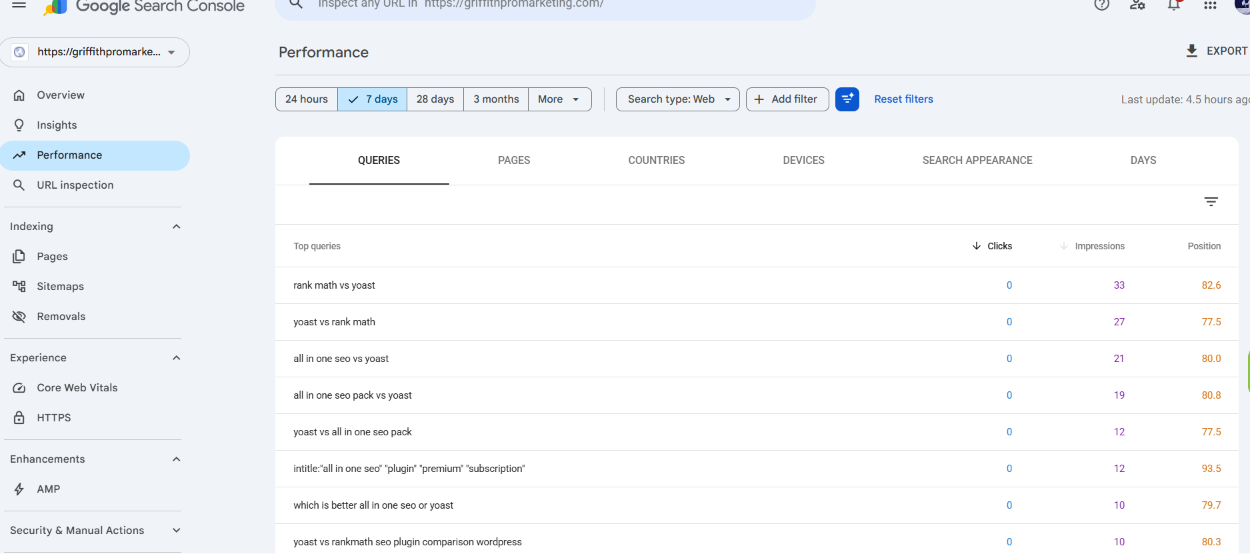
At the seven day mark, the top queries were “rank math vs yoast” with 33 impressions at an average position of 82.6, “yoast vs rank math” with 27 impressions at 77.5, “all in one seo vs yoast” with 21 impressions at 80.0, “all in one seo pack vs yoast” with 19 impressions at 80.8, “yoast vs all in one seo pack” with 12 impressions at 77.5, an oddly specific query in quotes targeting “all in one seo” plugin premium subscription language with 12 impressions sitting way out at position 93.5, “which is better all in one seo or yoast” with 10 impressions, “yoast vs rankmath seo plugin comparison wordpress” with 10, and “better than yoast” with 9 at a comparatively strong position of 69.0.
Look at that list again. Every single one of those queries is a variation on the exact same comparison. Rank Math versus Yoast. All in One SEO versus Yoast. Yoast versus All in One SEO Pack. Different word orders, different phrasing, same underlying question. And at this point, we did not have three separate pages built to catch each of those variations individually. We had two: the big three-way comparison, and two thinner dedicated posts we’d published early on, one titled “All in One SEO vs Yoast” and another titled “Yoast vs Rank Math.” Which meant we were about to find out something uncomfortable.
Twenty-eight days in: the numbers grow, but so does the mess underneath them
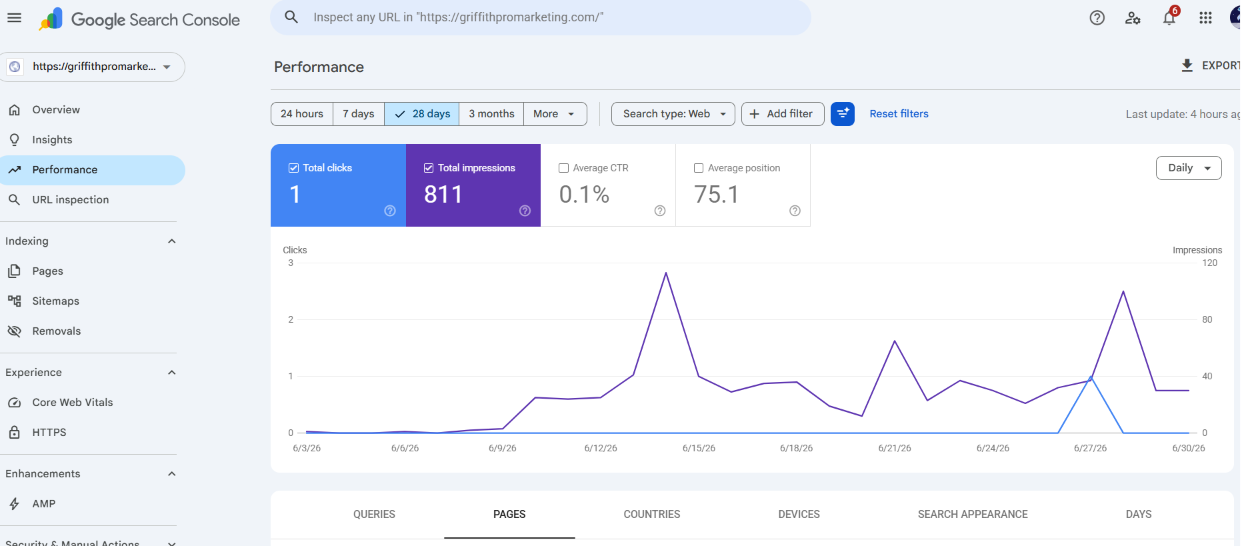
By the 28 day mark, total impressions had climbed to 811, still against just one total click, dragging average CTR down to 0.1% and average position to 75.1. On the surface, that CTR drop looks like the site was sliding backward. It wasn’t. It’s what happens mathematically when you go from three or four pages being tested by Google to more than a dozen pages simultaneously entering the index at low positions. Every new page starts near the bottom, and every new page pulls the average down with it until it has time to climb. What actually mattered at this stage wasn’t the average, it was the shape of the query data underneath it.
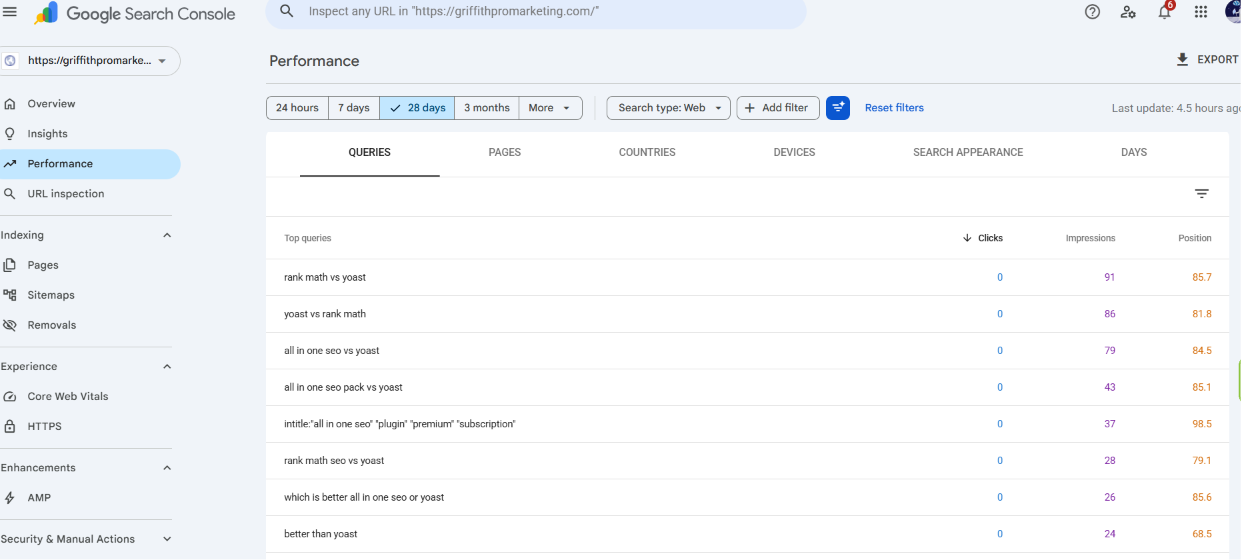
At 28 days, “rank math vs yoast” had grown to 91 impressions at position 85.7. “Yoast vs rank math” sat at 86 impressions, position 81.8. “All in one seo vs yoast” had climbed to 79 impressions at 84.5. “All in one seo pack vs yoast” reached 43 impressions at 85.1. That same odd bracketed query about all in one seo plugin premium subscription language had grown to 37 impressions, still stuck way out at position 98.5. “Rank math seo vs yoast” showed up fresh at 28 impressions, position 79.1. “Which is better all in one seo or yoast” reached 26 impressions. “Better than yoast” had grown to 24 impressions at a genuinely decent position of 68.5, the best position on the whole list. And “yoast vs all in one seo pack” and “yoast seo vs all in one seo pack” were sitting at 24 and 23 impressions respectively.
Here’s the part that actually changed how we thought about the site. Every one of those query variations was climbing in impressions. But almost none of them were climbing in position. Several were getting worse, not better, even as impression volume grew. Rank Math vs Yoast went from position 82.6 at seven days to 85.7 at 28 days. Yoast vs Rank Math went from 77.5 to 81.8. More people were seeing the pages, fewer of them were seeing them anywhere near the top of a results page. That’s not what healthy growth looks like. That’s what keyword cannibalisation looks like from the outside, several pages on the same site all trying to answer the same question, splitting the relevance signal Google would otherwise concentrate on one strong page, and dragging each other down instead of lifting each other up.
The one query that didn’t fit that pattern is worth sitting with for a second, because it’s the exception that proves the rule. “Better than yoast” sat at position 69.0 at seven days and improved to 68.5 at 28 days, the best position anywhere in the entire data set, and the only query trending in the right direction. That’s not a coincidence. “Better than yoast” isn’t a head-to-head comparison term the way the others are, it’s a single, distinct phrase that only one of our pages was ever realistically going to answer. There was no internal competition for it, no second or third post on the site trying to claim the same territory, so Google didn’t have to choose between our own pages, it just had one clear answer to give. Every other query on that list was being fought over by our own content. That one wasn’t, and it’s the only one that actually got better instead of worse. If you needed a single data point to justify the decision to consolidate, that’s the one.
There’s also a math lesson buried in the CTR numbers that’s worth being straightforward about, because it’s easy to misread. A 0.1% click-through rate sounds like something is badly broken. It isn’t, at least not in the way it looks. Average position in the mid-70s to mid-80s means these pages are landing somewhere around page eight or nine of Google’s results for most of these queries, and the honest, unglamorous truth is that almost nobody clicks past page one, let alone page eight. A 0.1% CTR at position 80 isn’t a warning sign, it’s just what position 80 looks like. The number that actually matters at this stage isn’t CTR, it’s whether impressions are growing and whether the query set is expanding to cover more of the topic, both of which were true. CTR becomes the metric worth worrying about once position starts closing in on the first page, not before.
The decision: pulling two posts back to draft
This is the part of the story that doesn’t show up in any Search Console export, because it happened in a planning doc, not in the data. Once the query overlap was obvious, we sat down and asked a plain question about each of the individual comparison posts: does this page exist because the topic genuinely needed its own dedicated treatment, or does it exist because it was fast to write and happened to rank for something.
The answer for two of them was uncomfortable. “All in One SEO vs Yoast” and “Yoast vs Rank Math” were both thin, both close variations of ground the flagship three-way comparison already covered more thoroughly, and both were actively pulling impressions and relevance away from the page we actually wanted to win with. Worse, the query data made it obvious that Google was already serving our three-way comparison for a good chunk of those exact search terms anyway, the pillar page was earning impressions on queries like “all in one seo vs yoast” and “which is better all in one seo or yoast” without needing a dedicated post at all. The thinner posts weren’t adding coverage, they were splitting it.
So we pulled them. Both went back to draft, not deleted, because the content itself isn’t worthless, it just doesn’t deserve to live as a standalone competing page right now. If they come back, it’ll be as genuinely different angles, maybe a pricing-specific comparison or a migration guide, something that earns its own URL instead of quietly cannibalising the page that was already doing the job.
That’s the piece of this case study we think matters most for anyone reading it as a playbook. It’s tempting to treat every ranking page as a win and leave it alone. The harder, more useful skill is looking at a page that’s technically getting impressions and asking whether it’s actually helping the site or just getting in its own way.
Rebuilding around pillars instead of a pile of posts
Once we made that call, it forced a bigger question: what should the site’s actual structure be, instead of a loose collection of posts published whenever a topic came to mind. We mapped out what we had and grouped it into three pillars, each with one page meant to be the strongest, most comprehensive entry point, and supporting posts meant to go deeper on specific angles underneath it.
The first pillar is SEO tools and plugins, anchored by the Rank Math vs Yoast vs All in One SEO comparison, which is now the clear flagship page on the entire site. Underneath it sits the MailerLite vs ConvertKit Australia comparison, which isn’t strictly an SEO plugin post but fits the broader “which WordPress tool should I actually use” intent the pillar is built around.
The second pillar is affiliate marketing in Australia, anchored by the Commission Factory Australia beginner’s guide, which also happens to be the only page on the site with an actual click so far. Supporting it is the affiliate marketing for beginners post and the affiliate disclosure page, which does double duty as both a trust signal and an internal link hub back into the affiliate content.
The third pillar is WordPress performance and technical fixes, built around the why my WordPress site was slow, and how WP Rocket fixed it in about twenty minutes post, with the fix website speed performance page, the fix SEO rankings and traffic post, and starting a WordPress site all sitting underneath it as supporting pieces.
The homepage and the enquire about digital marketing services page sit outside the three pillars on purpose, they’re the commercial layer, and every pillar page now links into the enquiry page as a natural next step rather than leaving readers with nowhere to go once they’ve finished reading.
What the interlinking actually looks like now
Structure on a page is one thing, but it only works if the links inside the content actually connect the pillars the way the map suggests. So the Rank Math vs Yoast comparison now links out to the MailerLite vs ConvertKit post in the section about choosing your broader WordPress stack, since someone comparing SEO plugins is very likely also picking their email tool around the same time. It also links down into the fix website speed performance post, because SEO plugin choice and site speed genuinely do affect each other, heavier plugins slow sites down, and that’s a natural, honest bridge between two pillars rather than a forced one.
The Commission Factory guide links across into the affiliate marketing for beginners post for readers who need the broader context before the specific platform walkthrough, and back into the affiliate disclosure page, which is both good practice and good for spreading authority to a page that otherwise has no organic pull of its own. It also links over into the enquire page for anyone who lands on the guide and would rather have someone build their affiliate strategy for them instead of doing it solo.
The WordPress speed fix post links into the fix SEO rankings and traffic post, since a slow site and a site with ranking problems are very often the same site described two different ways, and it links back up into the Rank Math vs Yoast comparison in the section about which plugin performs best on page speed, closing the loop back to the flagship page instead of leaving that link only flowing one direction.
None of these links are stuffed in for the sake of it. Every one of them exists because the two topics genuinely relate to each other, which is really the whole test for whether an internal link is doing its job or just padding a page.
Where the affiliate placement lives
The affiliate side of this sits inside the second pillar, specifically inside the Commission Factory guide and, to a lesser extent, the MailerLite vs ConvertKit comparison, both of which are genuinely reviewing tools with real referral programs behind them. Get started with Commission Factory here is the placement inside the guide itself, sitting right after the section explaining how the platform’s payout structure works, which is the natural point a reader is ready to act rather than a link dropped in above the fold before they know why they’d want it.
One honest note here: the link above is currently pointing at the internal guide page rather than a live tracked affiliate URL, because that real Commission Factory tracking link hasn’t been shared yet. Once it is, that’s a one-line swap, same placement, same context, just pointed at the actual program instead of the guide about the program.
What the numbers actually tell us, twenty-eight days on
Strip away the story and the raw numbers still say: one click, 811 impressions, average position in the mid-70s, a site that is, by any conventional measure, still very early. But the query data underneath that top line tells a more useful story than the top line does on its own. Every query variation around the Rank Math vs Yoast topic grew in impressions across all 28 days, meaning the topic itself has real, sustained search demand, this wasn’t a lucky spike. The fact that position didn’t improve alongside that impression growth, and in several cases got slightly worse, was the exact signal that told us cannibalisation was happening before it became an obvious problem. And the decision to pull two posts rather than let them keep competing with the pillar page is the kind of correction that’s much easier to make at day 28 with a dozen pages in the index than it would be at month six with fifty.
What the next 28 days needs to prove
The plan from here isn’t complicated. Watch whether pulling those two posts actually consolidates the ranking signal the way we expect, meaning the Rank Math vs Yoast pillar page should start climbing in position even as the redundant competition disappears from the index. Build the next layer of the SEO tools pillar with content that’s genuinely different rather than another variation of the same comparison, maybe a pricing breakdown or a migration guide between plugins. And keep testing whether the interlinking between pillars is actually moving authority the way it’s supposed to, which we’ll be able to see in the next Search Console pull once these changes have had time to settle.
Twenty-eight days in, this isn’t a finished case study, it’s the first real chapter of one. But it’s a chapter with an actual decision in it, not just a graph, and that’s the part worth remembering if you’re building a site of your own and wondering whether every page that gets impressions deserves to stay live.
If there’s one thing worth pulling out of all this for anyone reading it as a guide rather than just a story, it’s that Search Console rewards patience with pattern recognition long before it rewards you with rankings. Nothing in these 28 days was dramatic on its own. No single day looked like a breakthrough. What made the data useful wasn’t any individual number, it was watching the same handful of queries show up across three different time windows and noticing that impressions and position were moving in opposite directions for most of them. That’s not something you catch by checking the dashboard once and feeling good about a total impressions count going up. It’s something you catch by actually reading the query list slowly, more than once, and asking why a page that’s getting seen more often isn’t also climbing.
It’s also worth saying plainly that the decision to draft two live, ranking pages wasn’t an easy one to make in the moment. Both posts were technically working, in the narrow sense that they were indexed and pulling in real search traffic. Pulling them felt, for about a day, like giving up ground we’d already won. But rankings on a brand new site aren’t really a bank account where every page is a separate deposit. They’re closer to a single reputation being built one signal at a time, and every page competing with another page for the same territory is a signal working against itself. Once we started thinking about the site that way, instead of as a collection of individually scoring pages, the decision stopped being difficult.
The next update to this case study will most likely come around the 60 day mark, once there’s been enough time to see whether consolidating the SEO tools pillar actually moved the flagship comparison’s position the way the theory predicts. If it works, the same audit is getting run against the affiliate marketing and WordPress performance pillars next, because there’s no reason to assume the pattern found in one cluster is unique to it. If it doesn’t work, that’s useful too, because it means the position drag on those queries was coming from somewhere other than internal competition, and that’s a different problem worth chasing down. Either way, the plan is to keep publishing this journey with the real numbers attached, mistakes and all, because the sanitised version of this story would have been a lot less useful to write, and probably a lot less useful to read.