Rank Math SEO Score Experiment: From the 60s to 80+
A real SEO experiment using Rank Math and Google Search Console
Improving your Rank Math SEO Score is one of the clearest ways to make sure your content ticks off the essential on-page checks. I spend a fair bit of time talking about SEO, website performance, and the steps small business websites can take to grow.
But there is a common problem with giving SEO advice.
It is very easy to say something should work without actually testing it.
So I decided to use my own website, Griffith Pro Marketing, as the test environment.
Instead of changing everything at once, I worked through the site’s pillar pages to lift their overall Rank Math SEO Score using Rank Math.
The Rank Math link above is an affiliate link, it’s also the actual plugin used throughout this experiment.
Most of the pillar pages started with scores in the 65 to 70 range. One page was particularly poor, with a score of 0.
After working through the recommendations, the pillar pages are now scoring 80+ in Rank Math.
That sounds like a solid improvement.
But there is something much more important I need to find out:
Did Google actually respond to the changes? That answer isn’t available yet. And that’s exactly why I’m documenting the experiment.
The Starting Point for Each Rank Math SEO Score
When I started looking at the pillar pages, the Rank Math SEO Score baseline was not where I wanted it to be.
Most were sitting around:
- 65 to 70 out of 100
One was at:
- 0 out of 100
The pages were already published, but there was clearly room to improve how the content was structured and how the important SEO elements were being handled.
Rather than trying to optimise every page at once, I started working through the recommendations systematically.
The goal wasn’t simply to make the numbers look better. I wanted to see what happened when I actually applied the recommendations and then tracked the results.
A High Rank Math SEO Score Is Not a Direct Google Ranking
This distinction became important very quickly.
Rank Math gives a page an optimisation score based on the SEO recommendations built into the plugin. It can check things such as:
- Focus keyword placement
- SEO title
- Meta description
- Headings
- Content length
- Keyword usage
- Links
- Other on-page elements
That makes it useful as a checklist. But Rank Math does not hand out a Google ranking score.
Google does not see a page with a Rank Math SEO Score of 85 and decide it automatically deserves position 10.
So when my pillar pages moved from the 60s and 70s into the 80s, I didn’t want to immediately call that an SEO win. All I’d proved at that point was that I’d improved the pages against Rank Math’s own criteria.
The real test would come from Google Search Console.
How I Lifted My Rank Math SEO Score From the 60s to 80+
I worked through the pages and made the relevant on-page changes rather than simply stuffing in keywords wherever I could.

The focus was on making the pages clearer and better aligned with their intended topics. This included reviewing things such as:
- SEO titles
- Focus keyword placement
- Content wording
- Keyword relevance
- Headings
- Meta information
- On-page structure
The scores gradually moved upwards.
The important result was that the pillar pages that had mostly been sitting in the mid 60s to 70 range were now 80+. That was a clear, measurable change to the Rank Math SEO Score.
But there was an interesting lesson along the way.
Not Every SEO Change Lifted the Score
One of the things I wanted to record honestly was the changes that didn’t produce an obvious result.
At one point, I adjusted wording and keyword usage expecting the Rank Math SEO Score to climb. It didn’t. The score stayed the same.
That was a useful reminder. Adding more of a keyword doesn’t automatically produce a higher optimisation score.
More importantly, it reminded me why I don’t want to treat keyword density as the entire SEO strategy. There is a difference between making a page clearer about its subject and simply repeating the same phrase over and over.
If a sentence sounds unnatural because I’m trying to satisfy a plugin, I’ve probably gone too far.
The Result: Pillar Pages Are Now 80+
After working through the optimisation process, every target page’s Rank Math SEO Score is now generally sitting above:
- 80 out of 100 in Rank Math
That’s a solid improvement from where many of them started.
But this is where I deliberately stopped. I’m not pushing the scores towards 90 or 100 just because I can.
There’s a point where chasing the plugin score becomes less useful than watching what happens in the real search results. So now I need to leave the pages alone long enough to collect evidence.
What Was Already Happening in Google Search Console?
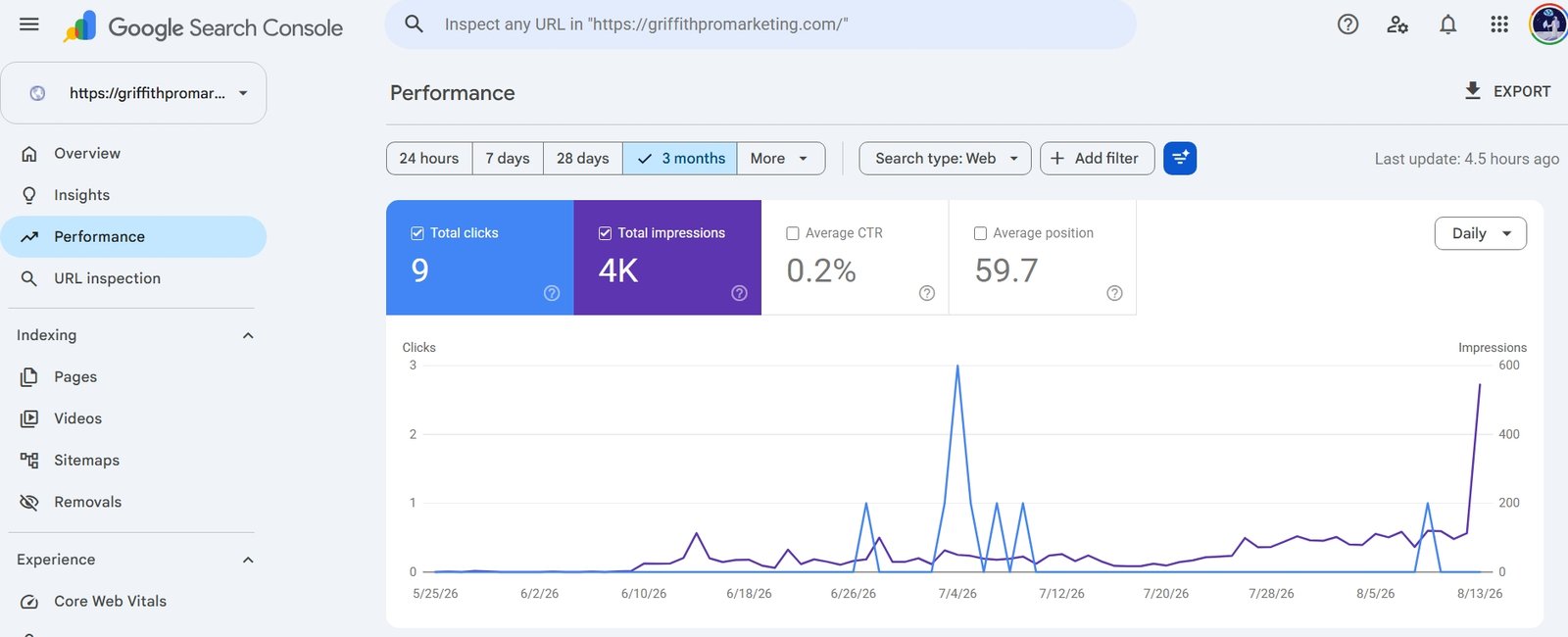
This is where the experiment gets more interesting.
Before crediting the latest round of optimisation with anything, I wanted to establish what Google Search Console was already showing.
The current three month Search Console view covers roughly 25 May to 13 August 2026. The numbers are:
| Search Console metric | Current 3 month data |
|---|---|
| Total impressions | 4,000 |
| Total clicks | 9 |
| Average CTR | 0.2% |
| Average position | 59.7 |
At first glance, those numbers don’t look particularly impressive. Nine clicks from 4,000 impressions is very little traffic. An average position of 59.7 also means the site is generally appearing well below the first page.
But there’s something in the graph I find more interesting.
Impressions are rising.
The Visibility Trend Is More Interesting Than the Traffic
Looking at the three month graph, the site spent a long stretch with fairly low visibility. Then, towards the end of the period, impressions began to climb.
The graph shows noticeably higher daily impressions through late July and into August, with another solid spike near the end of the displayed period.
That tells me something important. The site is getting more opportunities to appear in Google search than it was earlier in the three month period.
But it doesn’t yet mean the SEO experiment has succeeded.
Why? Because impressions aren’t clicks.
The site can appear for searches without receiving meaningful traffic from those searches. And that’s exactly what the current numbers show.
4,000 impressions have produced only 9 clicks. That gives a CTR of just 0.2%. So there’s a clear gap between visibility and traffic.
The Uncomfortable Part: 4,000 Impressions Is Not the Same as 4,000 People Seeing the Site
This is an easy mistake to make when looking at Search Console.
Four thousand impressions sounds like a lot. But an impression simply means the site appeared in a Google search result. It doesn’t mean someone noticed it. It doesn’t mean someone read the result. And it certainly doesn’t mean someone visited the website.
The current data gives me two different signals:
Positive signal: The site is gaining search visibility. The impression graph is trending upwards, particularly towards the end of the period.
Weak signal: That visibility isn’t yet translating into many clicks. Only nine clicks were recorded across roughly three months.
That means the next challenge isn’t simply getting impressions. It’s getting the right impressions and turning them into clicks.
So Did the Rank Math Optimisation Cause the Increase?
We can’t say that yet.
This is probably the most important part of the experiment.
The Search Console graph already shows an increase in impressions towards the end of the three month period, and that increase started before this latest round of pillar page work was even finished. The optimisation that pushed every page’s Rank Math SEO Score above 80 happened much more recently than the start of that upward trend.
That means this screenshot, taken after the pages hit 80+, can’t be used as proof that lifting the Rank Math SEO Score above 80 caused the increase. The rise was already in motion beforehand.
There’s a timing problem too. Google needs time to crawl and process changes. Search Console also reports data with a delay.
So if I made the latest optimisation changes today and immediately checked Search Console, it would be unreasonable to expect the graph to suddenly show the effect. SEO doesn’t work that quickly.
This Is Why I’m Not Declaring Victory
It would be very easy to write this article differently. I could say:
“I lifted my Rank Math SEO Score from the 60s to 80+, and my Google impressions increased.”
Technically, those two things may both be true. But that wording would strongly imply that one caused the other, and I don’t have enough evidence to make that claim.
The increase in impressions was already visible in the Search Console data. There are too many possible explanations for the movement:
- Google may have discovered more of the site.
- The pages may have started appearing for more queries.
- The site’s overall visibility may be developing naturally.
- Other pages may be generating impressions.
- Search demand may have changed.
- Google’s systems may have changed.
And the latest Rank Math optimisation may well contribute to further improvement down the track. But we need more data before we can tease those possibilities apart.
What the Current Experiment Actually Proves
At this point, I can confidently say four things:
1. The pillar pages were under optimised according to Rank Math
Most were around 65 to 70, with one page scoring 0.
2. The pages are now much better aligned with Rank Math’s on-page recommendations
The pillar pages now achieve a high Rank Math SEO Score of 80+.
3. Google was already showing rising visibility
The three month Search Console data shows roughly 4,000 impressions and a noticeable increase in impressions towards the end of the period.
4. Traffic hasn’t caught up with visibility
There were only 9 clicks, with a 0.2% CTR and an average position of 59.7.
That means the real opportunity now isn’t simply pushing the Rank Math number higher. It’s finding out whether the improved pages can eventually earn better positions and more clicks.
What I’m Watching Next
This is where I’m drawing the line between Part 1 and Part 2. I’ve finished the major Rank Math SEO Score work. The pillar pages are now 80+. Now I’m waiting.
I want Google Search Console to have enough time to reflect the changes. In the next stage, I’ll compare:
- Impressions before and after the optimisation
- Clicks before and after
- CTR
- Average position
- Which search queries are appearing
- Whether the pillar pages themselves are gaining visibility
- Whether rankings are moving closer to page one
- Whether impressions are turning into actual traffic
The most important measurement won’t be whether Rank Math reaches 90. It’ll be whether the pages start performing better in Google.
Part 2: Waiting for Google to Reflect the Changes
This experiment is therefore not finished.
Part 1 is about the optimisation. The Rank Math SEO Score results have moved from the 60s and 70s into the 80+ range.
Part 2 will be about the outcome. I’m now leaving the changes in place and waiting for Google Search Console to collect enough data.
Then I can come back and ask the question that actually matters:
Did improving the Rank Math SEO Score improve the site’s search performance?
Maybe the answer will be yes. Maybe the improvement will be small. Maybe the pages will gain impressions but still struggle to generate clicks. Or maybe the Rank Math score will improve dramatically while Google’s rankings barely budge.
Any of those results would be useful, because the point of this experiment isn’t to prove that Rank Math works. It’s to find out what actually happens when I use it on a real website.
For now, the only conclusion I’m comfortable making is this: the on-page optimisation improved, the site’s Google visibility was already showing signs of growth, but it’s still too early to connect the two.
So I’m leaving the pages alone and waiting for Google to hand over the next piece of evidence. Part 2 will come once Search Console has had time to properly reflect the changes.